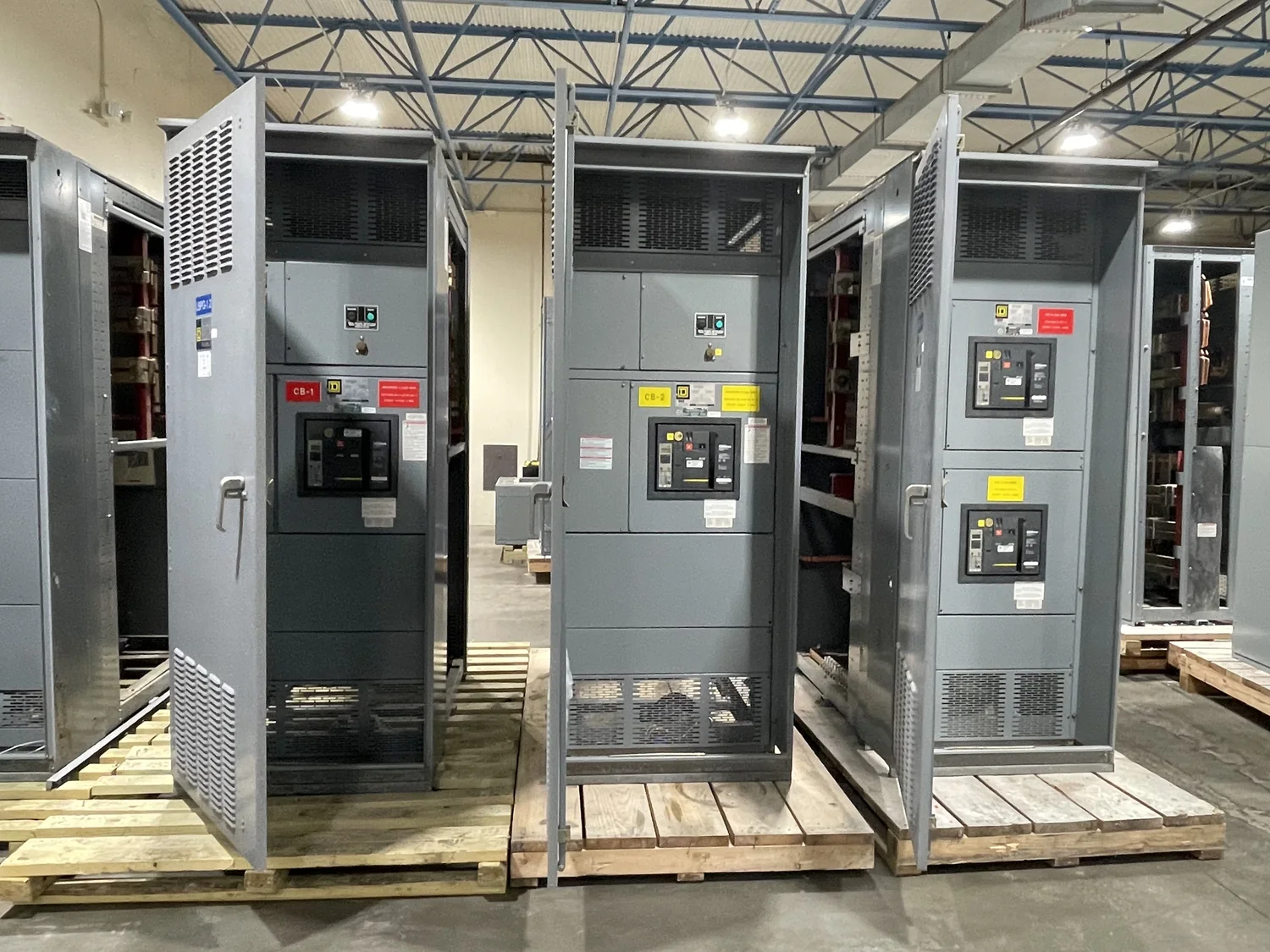
Sell Used Motor Control Centers in the Washington, DC Region
If your organization is considering selling a used motor control center (MCC), a clear equipment review is the best place to begin. Commercial, institutional, and industrial sites across Washington, DC, Northern Virginia, and Maryland may have different access rules, operating schedules, and removal constraints. Those details can affect how an MCC is assessed and how a project is planned, so they should be discussed before a removal date is set.
We buy used motor control centers and consider equipment across all voltage classes. We can make a cash offer, and payment is arranged upfront when an offer is accepted. The seller is not required to test the equipment. An initial review can start with photographs, nameplate information, lineup dimensions, ownership details, and a description of site access. A final offer depends on review of the specific equipment and project conditions; it should not be assumed from a brief description alone.
Prepare Photos, Nameplates, and Lineup Details
Begin with clear, well-lit photos that show the MCC lineup as a whole, its surroundings, and any visible sections, compartments, or attached components included in the proposed sale. Close-up images of nameplates and identification labels can help establish the available manufacturer, model, ratings, and other marked details. Do not remove covers or enter restricted areas just to obtain a photograph. Follow the facility’s access and safety procedures, and have qualified personnel determine what can be photographed safely.
Share lineup dimensions, including approximate height, width, and depth, and note how many sections are included. If available, provide documentation that helps describe the configuration and completeness, such as equipment schedules or drawings. Mention known missing, damaged, modified, or separately stored components rather than assuming they are part of the lineup. Ratings and completeness may matter to the review, but no particular rating or manufacturer is presumed to qualify the equipment. If a label is unreadable or a detail is unknown, say so; a straightforward account is more useful than an unsupported guess.
Confirm Ownership, Scope, and Site Access
Before an offer is finalized, identify who owns the MCC and who is authorized to approve its sale. For equipment at a leased, shared, managed, or institutional site, confirm internally that the person coordinating the inquiry can represent the owner and arrange site access. Clarify exactly which equipment is included, whether adjacent gear or associated components are excluded, and whether the lineup must be removed as a complete assembly or in agreed sections. These details help keep the sale scope distinct from other assets at the facility.
Access planning is especially important in the DC region, where project arrangements may need to account for building rules, delivery or work windows, loading areas, security procedures, and coordination with facility operations. Conditions vary by site, so provide the practical details rather than assuming a standard route or schedule. Useful information includes the equipment’s floor or location, doorway and corridor clearances, elevator or stair limitations, distance to the loading point, overhead restrictions, and any restrictions on staging or vehicle access. Photos of the route and loading area can help identify questions to resolve before removal is scheduled.
Plan Qualified Disconnection and Removal
Any de-energization, isolation, and disconnection must be performed by qualified personnel under the site’s safety requirements and outage procedures. Do not have unqualified staff disconnect, dismantle, or handle electrical equipment. The facility and its authorized personnel should determine the required work, establish the safe condition, and coordinate timing with the buyer before removal. If the MCC is part of an operating system, the facility should plan its own operational requirements and outage approvals; the purchase discussion is not a substitute for that work.
Subject to project arrangements and site access, the buyer handles crane, rigging, disconnects, loading, freight, and hauling. Responsibilities, sequence, and timing should be confirmed for the specific project before removal begins. Crane or rigging needs may depend on the lineup’s dimensions, weight information if available, condition, route, lifting constraints, and the space available at the site. Share known removal restrictions early, including limited access, tight turns, overhead obstacles, restricted work hours, or requirements for a particular loading area. No removal method or schedule should be treated as confirmed until the parties have reviewed the actual conditions.
Review the Offer and Coordinate Payment
Once the equipment description, photographs, ownership, scope, and logistics are available, we can review the opportunity and make a cash offer where appropriate. The seller does not need to perform testing as a condition of submitting the equipment for consideration. If existing documentation or known condition information is available, it can be shared, but do not represent unverified details as confirmed facts. A price cannot be responsibly stated without reviewing the specific MCC and the proposed removal arrangements.
When an offer is accepted, payment is arranged upfront. Before setting the project in motion, confirm the accepted scope, payment arrangement, site contact, access plan, timing, and removal responsibilities. The buyer pays the crane, rigging, loading, freight, and hauling costs, with project responsibilities confirmed before removal. A well-prepared inquiry—with clear photos, nameplates, lineup dimensions, ownership and access details, and any known removal constraints—helps both sides evaluate the equipment and plan a practical next step across Washington, DC, Northern Virginia, and Maryland.