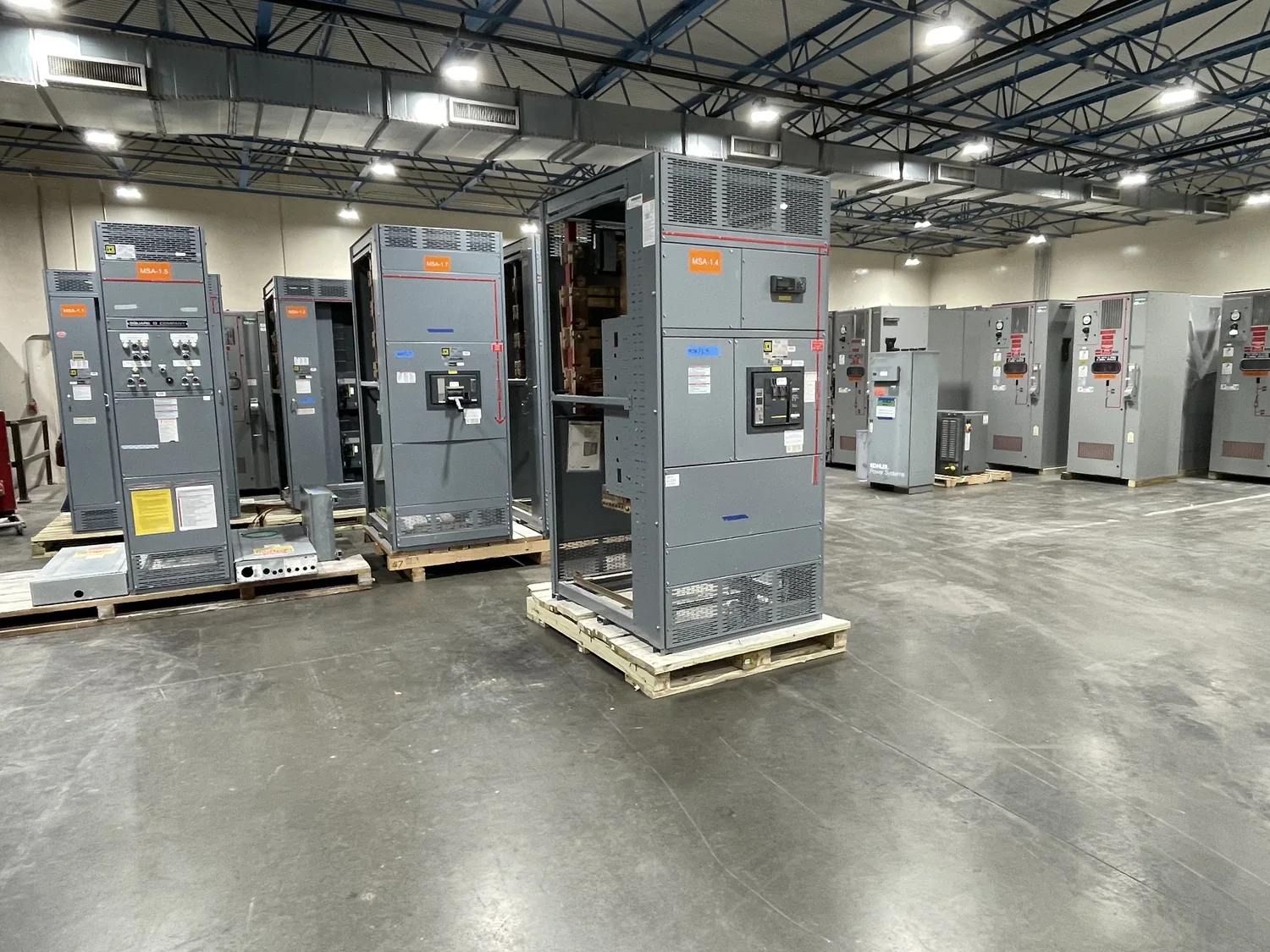
Sell Used Panelboards in the Washington, DC Region
If your business or institution is planning a renovation, equipment replacement, consolidation, or facility decommissioning, used panelboards may be candidates for resale rather than disposal. We buy used panelboards from commercial, institutional, and industrial sites across Washington, DC, Northern Virginia, and Maryland. We are a buyer, not a seller: we review the equipment and project details, make an offer when the information supports one, and pay upfront once an offer is accepted.
Every panelboard is evaluated in context. Age, condition, configuration, completeness, and the practical work required to remove it can affect whether a purchase makes sense. We consider all voltage classes, but that does not mean every unit will receive an offer. A review of the equipment and site logistics is needed before scope or price can be determined; a final price cannot be established from a brief description alone. Seller testing is not required.
Prepare Photos, Nameplates, and Lineup Details
A useful first submission includes clear, well-lit photos of the panelboard exterior, interior where it is safe and authorized to photograph, and the surrounding installation. Include close-up images of each readable nameplate and any labels that help identify the equipment. Do not remove covers or enter restricted electrical areas to take photographs. If interior images cannot be obtained safely under site procedures, exterior views and available records are still helpful starting points.
Share the number of units and, where available, manufacturer and model information, ratings, configuration, and a description of what is included. Photos of breakers or other components can help clarify completeness, but do not assume that every component must be individually documented before the initial review. Note missing parts, visible damage, corrosion, modifications, or other known condition concerns plainly. Clear disclosure helps the buyer assess the panelboard as it exists rather than relying on assumptions.
Provide approximate lineup dimensions, including height, width, and depth, and indicate whether the equipment is a single section or part of a larger lineup. If exact measurements are not available, label estimates as estimates. Dimensions, weight information if known, the route from the installation to the pickup point, and any narrow doors, stairs, elevators, loading limits, or other access restrictions can affect removal planning. Do not put yourself or unqualified staff at risk to obtain measurements; share what site personnel can confirm safely.
Confirm Ownership, Site Access, and Removal Scope
Before a purchase scope is set, establish who owns the panelboards and who has authority to approve their sale. If equipment is leased, financed, subject to a lien, or controlled by another party, resolve the relevant authorization before arranging a transaction. For institutional and commercial asset dispositions, identify the person who can coordinate approvals, building access, outage timing, and removal requirements. No sale should be treated as approved until ownership and authority are sufficiently clear.
The DC region includes sites with varied building layouts and operating requirements, so access and scheduling should be described for the specific project rather than assumed. Share the pickup location within the service area, available loading access, operating-hour limits, security or check-in procedures, and any restrictions on vehicles or equipment. If the panelboards are in an active facility, coordinate timing with the people responsible for operations and site safety. We do not assume a particular site layout, outage window, or removal route based on location alone.
Removal responsibilities and costs should be confirmed before the work is scheduled. The buyer handles crane, rigging, loading, freight, and hauling, subject to the agreed project scope and actual site access. The buyer also handles disconnects as arranged for the project, but electrical de-energization, isolation, and disconnect work must be performed by qualified personnel under the site’s safety and outage procedures. Coordinate the necessary personnel, permissions, timing, and access in advance. Do not ask unqualified personnel to disconnect, move, or handle electrical equipment.
Coordinate Technical and Safety Requirements
A panelboard’s installed condition matters as much as its identification. Let us know whether it is still installed, already removed, or staged for pickup, and describe any known connection to other equipment or building systems that could affect separation. Share available information about shutdown or outage procedures and any site-specific limits on work hours, noise, lifting, staging, or loading. These details are planning inputs, not substitutes for a qualified site assessment.
All voltage classes are considered, and no seller testing is required. Still, provide available nameplate ratings and records accurately, and distinguish documented facts from estimates or unknowns. Do not energize equipment or conduct tests for the purpose of making a submission. Any needed verification, de-energization, isolation, and disconnection must follow the site’s established procedures and be handled by qualified personnel. The buyer’s review of submitted information does not replace the facility’s safety controls or determine whether equipment is safe to operate.
For larger lineups or constrained removals, photographs and dimensions can help identify lifting, staging, and transport questions early. Note whether other equipment must remain in place, whether the panelboard is above or below grade, and whether the route includes steps, tight turns, low clearances, or a limited loading area. These observations help the parties discuss a workable plan, but final arrangements depend on project-specific access and scope. Do not move equipment, remove barriers, or alter site conditions to facilitate a preliminary review.
Request an Offer and Plan the Pickup
To request a review, gather the panelboard photos, readable nameplates, approximate lineup dimensions, quantity, known completeness and condition, ownership confirmation, and site access details. Include your preferred timing and any outage, access, or removal constraints. If some information is unavailable, say so; an honest list of unknowns is more useful than an unsupported specification. The buyer can then determine whether more information or a site-specific discussion is needed before making an offer.
Offers are made only after review of the equipment and relevant project details. There is no guaranteed acceptance or price, and a final amount should not be inferred from voltage class, a photo, or dimensions alone. If an offer is accepted, payment is arranged upfront. Before removal, confirm in writing the equipment included, payment arrangement, schedule, access requirements, and the division of project responsibilities. The buyer pays the crane, rigging, loading, freight, and hauling costs, with the practical arrangements confirmed for the site.
For sellers in Washington, DC, Northern Virginia, and Maryland, early coordination can make an asset disposition easier to plan—especially when a facility has controlled access, an operating schedule, or a defined outage window. Start with accurate equipment information and a realistic description of the pickup conditions. That gives both sides a basis to assess the panelboards, agree on scope, and coordinate a removal plan without making assumptions about the facility or its electrical system.