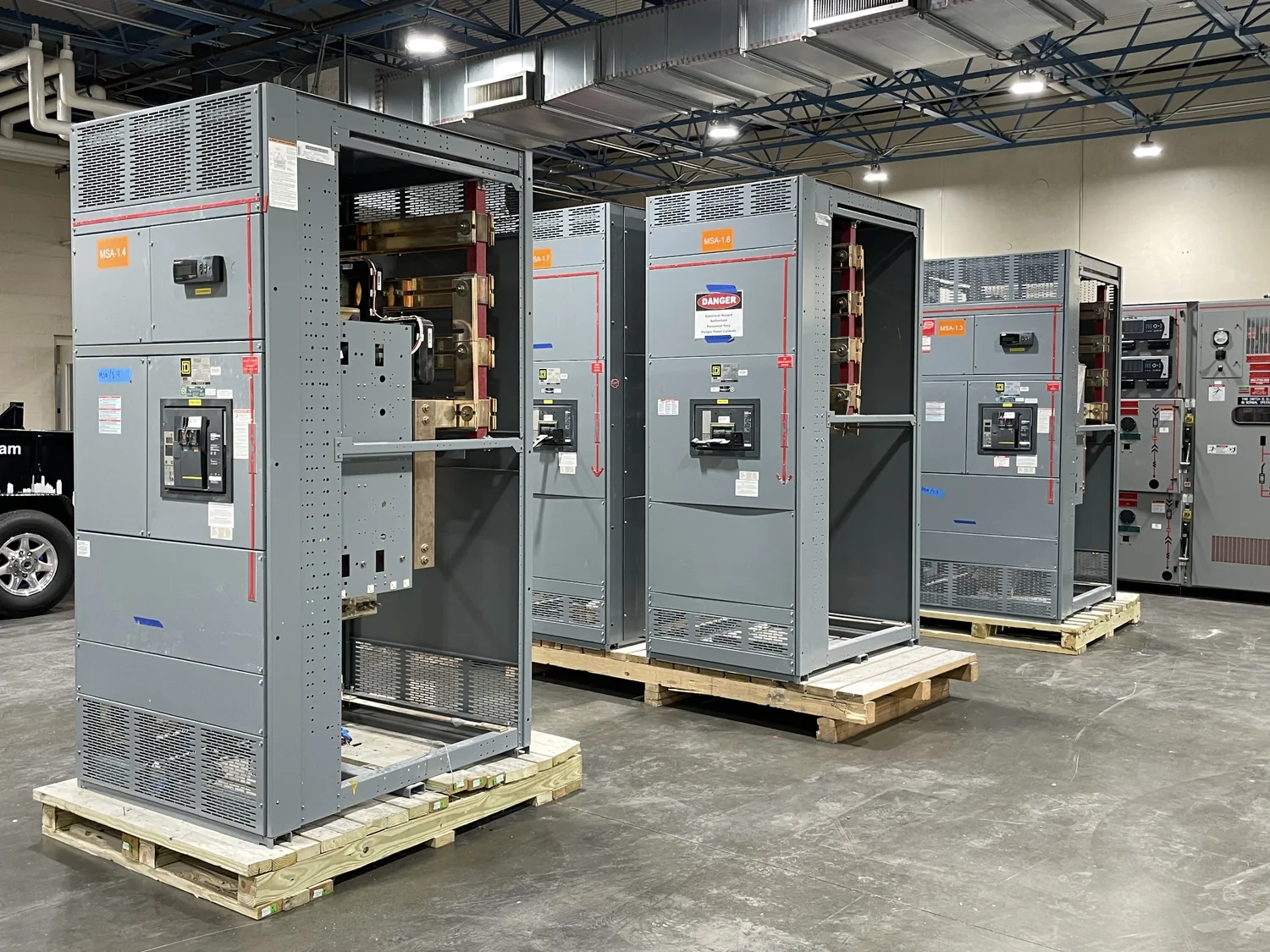
Switchgear warehouse clearout purchase in the DC region
A warehouse clearout can involve more than deciding whether a switchgear lineup has resale potential. Equipment may be stored alongside parts, accessories, documents, or other electrical assets, while the building schedule, loading route, and removal window all affect what can be taken and when. For sellers in Washington, DC, Northern Virginia, and Maryland, a clear scope at the outset helps keep equipment review and site coordination practical. The buyer purchases equipment; it does not sell switchgear or provide electrical installation services.
The buyer considers switchgear across all voltage classes. A seller does not need to arrange testing before requesting an offer. Instead, the initial review can start with clear photos, nameplate information, lineup dimensions, an inventory if available, and details about ownership and site access. These facts help identify what equipment is being offered and what the removal plan may require. They do not establish a final price by themselves: any offer depends on review of the specific assets and project conditions.
Document the equipment before setting scope
Begin with wide, well-lit photographs showing each lineup and its surroundings. Include front and rear views when access permits, plus close-ups of visible nameplates, labels, and sections that appear incomplete or damaged. Photograph loose components, protective covers, bus or compartment areas only where this can be done safely without opening equipment or exposing anyone to electrical hazards. Do not remove covers or approach energized equipment to obtain a picture. If a safe photograph is not possible, note that and arrange for qualified site personnel to provide the relevant information.
Nameplates and equipment labels may help establish manufacturer, model or type, ratings, configuration, and identification details. Capture the readable information rather than relying only on a handwritten description. Also report the number of sections, approximate lineup length, height and depth, and any irregular projections or attached equipment. Dimensions should describe the actual assembly and the space needed to move it—not just the footprint shown on a drawing. If drawings, bills of material, manuals, or an existing asset list are available, they may help clarify what is included, but the seller need not commission new testing to start a review.
Describe completeness as accurately as possible. Note whether breakers, relays, meters, doors, internal barriers, accessories, and other components are present, missing, separately stored, or of uncertain status. Identify obvious damage, modifications, or parts that have already been removed. Avoid assumptions about interchangeability or operating condition. The buyer can review the information provided, but photographs and records are not a substitute for a site-specific scope assessment, and the seller should not represent unverified condition as confirmed.
Confirm ownership, access, and removal constraints
Before discussing removal, identify who owns the equipment and who is authorized to approve its sale and release. If the warehouse is leased, shared, under a property manager, or subject to another party’s control, establish who can authorize access and removal. Clarify whether equipment is part of a larger asset-disposition process and whether any listed materials, documents, or components must remain on site. These checks help prevent a crew arriving before the seller has authority to release the assets or the building is ready for work.
Share the site address for the project, the proposed contact for access coordination, and practical details about the route from the equipment to the loading area. Relevant constraints can include door and ceiling clearances, corridors and turns, floor or loading-dock conditions, stairs, elevators, ramps, overhead obstructions, vehicle approach, parking or staging limits, and restricted building hours. In the DC region, access arrangements can differ from one property to another; do not assume a truck, crane, or rigging equipment can reach the lineup or remain on site without coordination. Provide measurements or photographs of tight locations where available, and flag any approvals or scheduling restrictions that could affect the work.
Explain whether the lineup is installed, disconnected, partially dismantled, or already staged, and whether other equipment or building operations could constrain the removal sequence. Tell the buyer about known lifting points, unusual dimensions, weight information, adjacent assets, and obstacles, if that information is documented. Do not estimate weights or lifting requirements unless you have a reliable basis. The buyer and seller should confirm responsibilities and the practical removal plan before work is scheduled.
Plan safe disconnects and coordinated removal
Any de-energization, isolation, and disconnect work must be performed by qualified personnel under the site’s safety rules and outage procedures. Do not ask unqualified staff, warehouse workers, or a removal crew to open, disconnect, or handle electrical equipment. Coordinate the outage window, equipment status, access permissions, and any required site supervision before removal. The buyer does not replace the seller’s qualified electrical personnel or the site’s safety and operating procedures.
The buyer handles crane, rigging, disconnects, loading, freight, and hauling, subject to project arrangements and site access. The exact division of work, sequence, timing, and any site-specific prerequisites should be confirmed before the removal date. Clear communication matters if equipment must be moved through an occupied facility, if the loading area is shared, or if access is limited to a defined time window. The seller should identify known restrictions early so the plan can be reviewed rather than assuming that standard loading arrangements will fit every warehouse.
Removal feasibility depends on the actual lineup, its condition and completeness, route dimensions, available staging space, and permitted work window. If the equipment must be separated into sections, identify that possibility during review; do not dismantle or alter it in advance unless the parties have agreed on the scope and qualified personnel are responsible for the work. A clear inventory of what is included—and what is excluded—also helps avoid confusion when other stored assets are nearby.
Request an offer and settle terms before pickup
To request a review, provide the equipment photos and nameplates, lineup dimensions, available records, completeness notes, ownership confirmation, and access and removal details. If some information is unavailable, say so rather than filling gaps with guesses. The buyer can use the submission to assess whether the equipment and project may fit a purchase, then follow up on questions needed to define scope. No final price should be assumed until the specific equipment and logistics have been reviewed.
The buyer can make a cash offer. If the seller accepts, payment is arranged upfront; the timing and method should be confirmed as part of the offer and project arrangements before removal. The buyer pays crane, rigging, loading, freight, and hauling costs, with responsibilities confirmed before removal. Because access and site conditions are project-specific, confirm who will coordinate entry, required timing, and any agreed prerequisites in writing. An accepted offer and an agreed removal plan give both parties a clearer basis for scheduling without promising a particular outcome before the equipment and site have been reviewed.